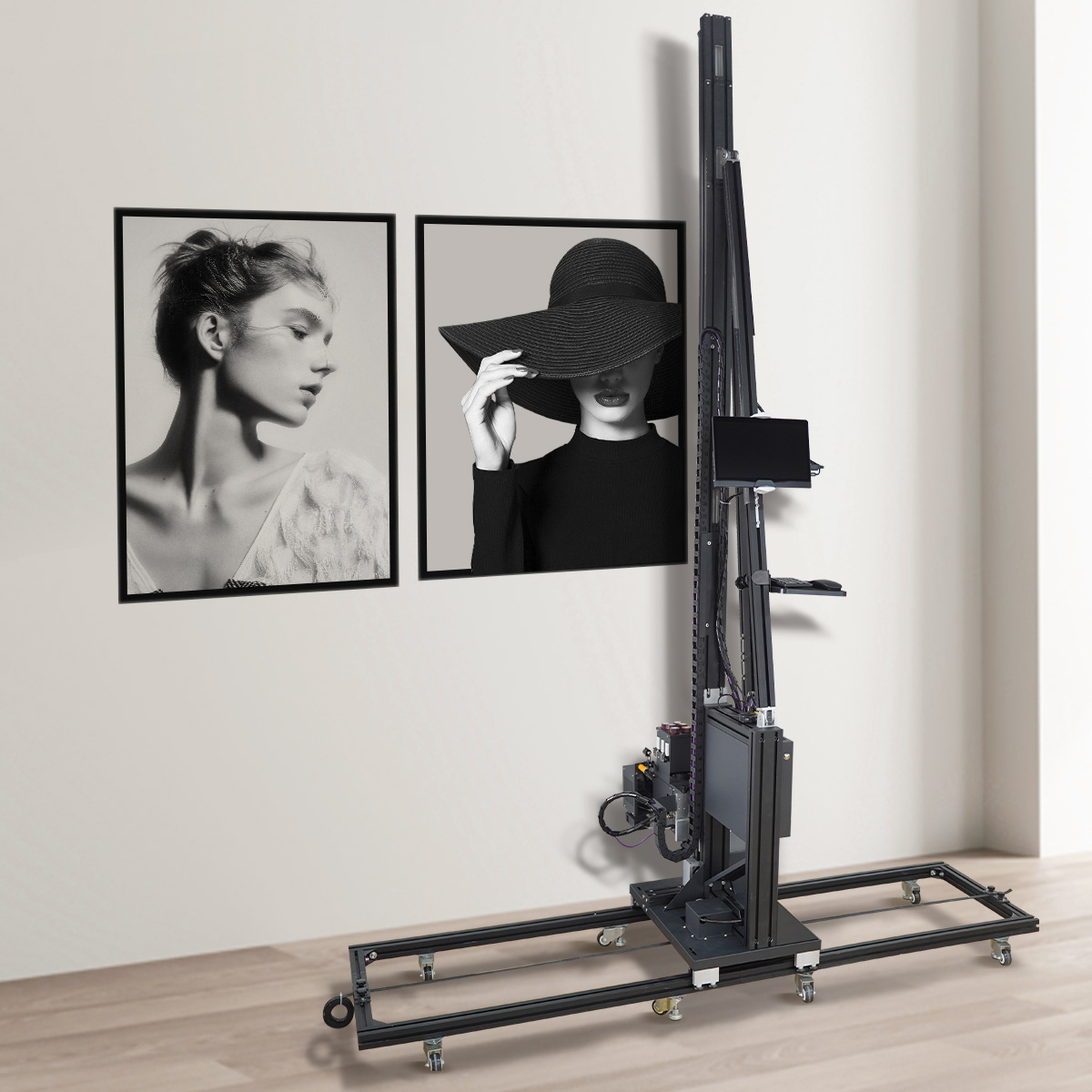
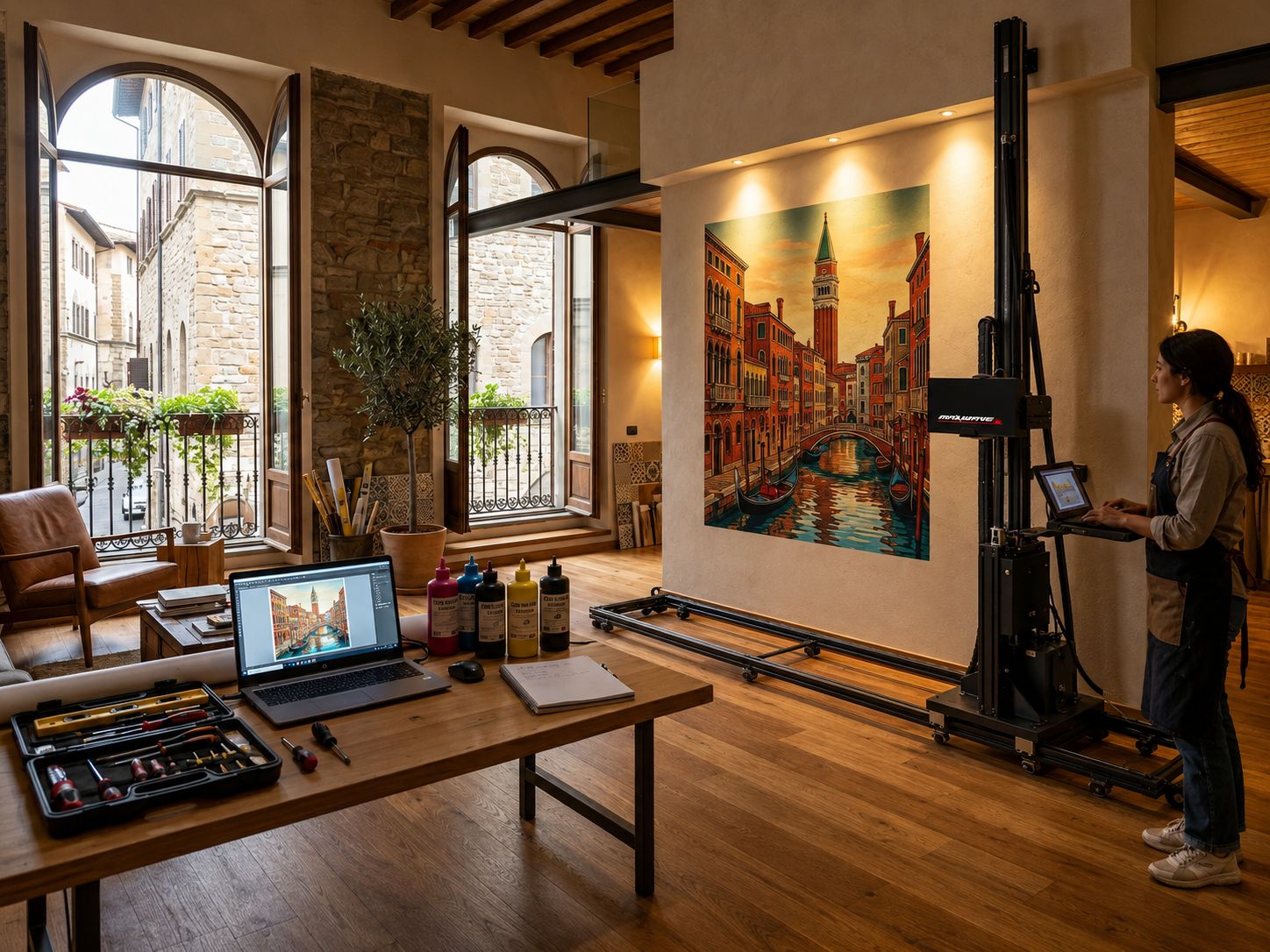
A modern UV wall printer can print on far more than standard painted drywall.
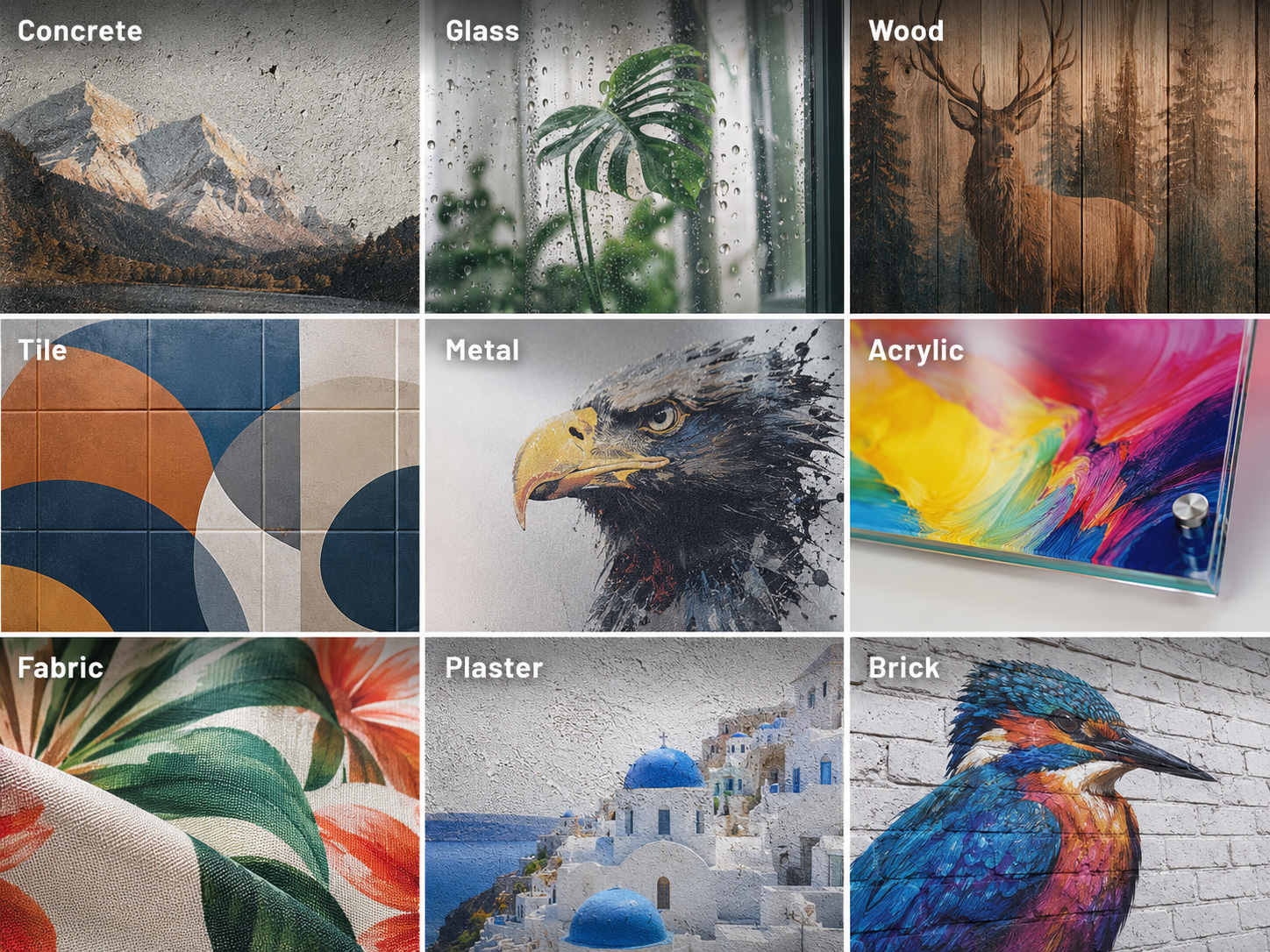
Depending on the ink system, distance sensors, surface condition, and preparation method, direct wall printing may work on plaster, concrete, brick, wood, glass, ceramic tile, metal, wallpaper, acrylic, PVC, and other rigid surfaces.
However, “printable” does not always mean “ready to print.”
A material may accept ink but still produce poor color, weak adhesion, blurred details, or premature peeling if it is damp, dusty, glossy, unstable, or excessively textured.
The safest answer is:
A wall printer can print on most clean, dry, stable, and reasonably even rigid surfaces—but the correct preparation and a sample test are essential.
Wall Printer Surface Compatibility at a Glance
Surface | Can It Be Printed? | Typical Preparation | Main Risk |
|---|---|---|---|
Painted drywall | Usually yes | Clean, repair and confirm paint is stable | Loose paint or visible wall defects |
Plaster | Usually yes | Remove dust, seal porous areas and repair cracks | Uneven absorption and surface texture |
Concrete | Yes, when cured and dry | Clean, repair, seal or prime when needed | Moisture, porosity and roughness |
Brick and masonry | Yes, with limitations | Clean, stabilize mortar and prime porous surfaces | Deep joints and uneven image detail |
MDF | Usually yes | Light sanding and cleaning | Dust and untreated edges |
Solid wood | Yes, after preparation | Sand, seal and control moisture | Grain showing through and movement |
Glass and mirrors | Yes, with pretreatment | Degrease and apply an adhesion promoter | Weak ink adhesion and reflection |
Ceramic tile | Yes, with pretreatment | Clean, degrease and test primer | Glossy glaze and grout joints |
Metal | Yes, after preparation | Degrease, lightly abrade and prime when required | Oil, oxidation and smooth surfaces |
Acrylic, PVC and ABS | Often yes | Clean and test adhesion | Surface chemistry and cleaner compatibility |
Wallpaper | Sometimes | Confirm adhesion, seams and surface coating | Loose panels, movement and uneven seams |
Soft or flexible material | Usually unsuitable | Use another printing method | Cracking, movement and poor positioning |
WallPrintBox UV wall printers are designed for more than standard painted drywall. With CMYK plus white ink, automatic wall-distance sensing, and adjustable material settings, they can work on a range of prepared surfaces, including plaster, brick, concrete, wood, glass, tile, and metal.
However, the correct pretreatment still depends on the material. Wall sensing controls the printhead distance, while primers, white ink, and print profiles control adhesion and color performance.
What Makes a Surface Suitable for Wall Printing?
Before comparing individual materials, check four basic conditions.
The Surface Must Be Stable
A wall printer machine cannot correct loose paint, crumbling plaster, damaged mortar, active cracking or unstable panels.
If the existing coating separates from the wall, the printed image will separate with it. Any damaged area should be repaired before printing begins.
The Surface Must Be Clean and Dry
Dust, grease, wax, silicone, construction residue and moisture can prevent the ink from bonding correctly.
Concrete, plaster and masonry should be fully cured and free from moisture problems. Glass, tile, metal and plastic normally require thorough degreasing because even a thin invisible film can affect adhesion.
The Texture Must Remain Within the Machine’s Working Range
Wall-distance sensing can help a printer follow small variations, but it cannot compensate for every surface.
Deep brick joints, heavily textured render, broken concrete and projecting decorative elements may create inconsistent printhead distance. This can cause blurred edges, missed areas or collision risk.
The exact texture tolerance depends on the printer and sensing system, so it should be demonstrated on a comparable material.
The Ink Must Be Compatible With the Material
Porous materials absorb ink differently from glass, metal or glossy tile.
Absorbent surfaces may need a sealer or primer to control ink penetration. Smooth, nonporous surfaces may require an adhesion promoter to help the cured UV ink remain attached.
A surface can be mechanically printable but chemically unsuitable without the correct pretreatment.
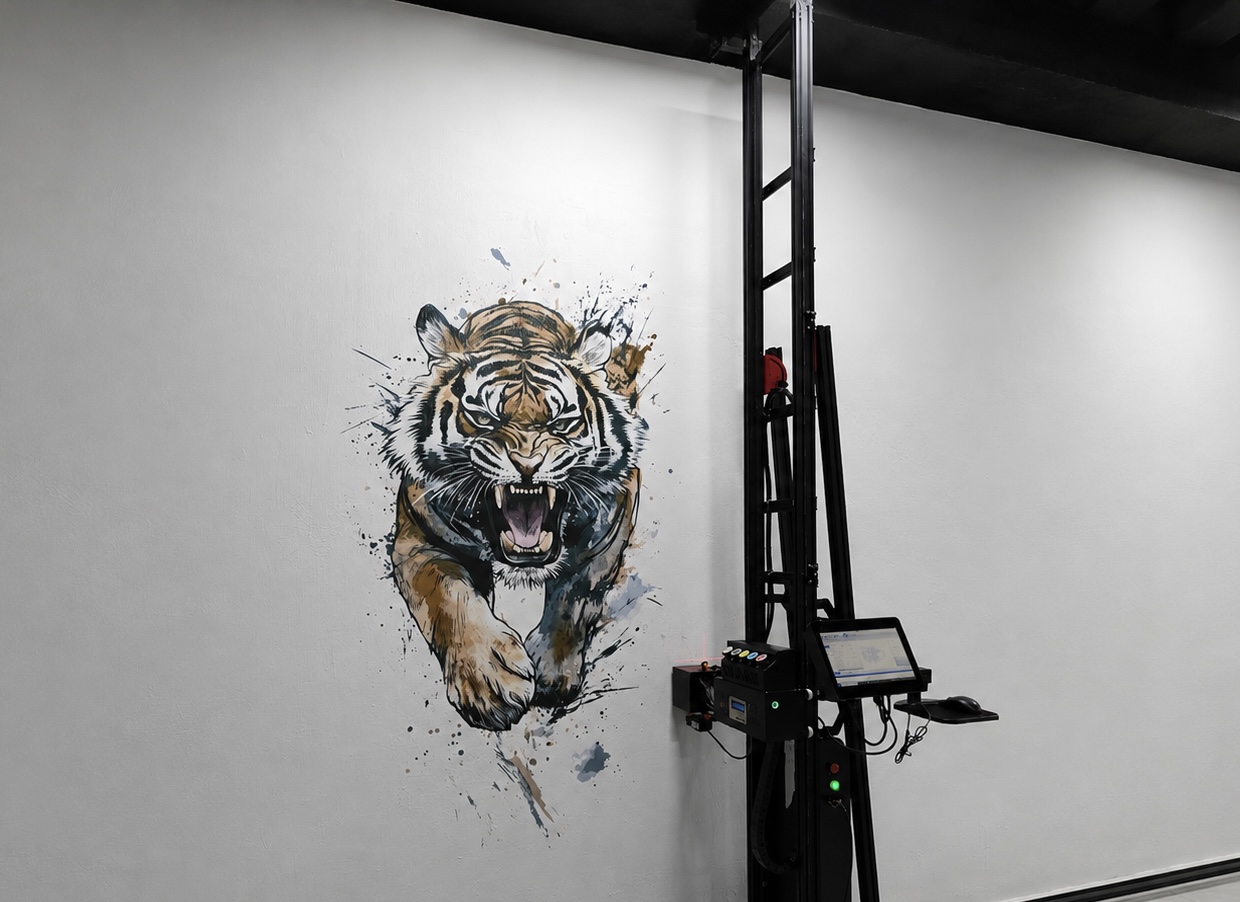
Painted Drywall and Plaster
Painted drywall is usually the easiest and most predictable surface for direct wall printing.
A smooth, matte or low-sheen wall can reproduce photographs, illustrations, text and gradients with good detail. Light-colored walls normally require only CMYK ink, while dark or strongly colored walls may need a white underlayer.
The most important requirement is that the paint is firmly attached.
Fresh paint should be fully cured before printing. Old walls should be checked for chalking, dust, grease, peeling edges, repairs and inconsistent texture.
High-gloss paint may need light sanding or an adhesion test. Raw drywall should normally be sealed or primed because untreated board and joint compound can absorb ink unevenly.
Plaster walls can also print well, but dusty or highly porous plaster may need a stabilizing primer.
Best for: Homes, offices, hotels, restaurants, retail spaces and detailed indoor murals.
Main limitation: Wall defects may remain visible beneath the image, especially under side lighting or in large areas of solid color.
Concrete and Cement Walls
Concrete is commonly used for industrial interiors, public spaces, parking areas, commercial buildings and outdoor murals.
A wall printer can print directly on cured concrete when the surface is dry, stable and reasonably even. Smooth poured concrete usually produces better detail than rough blocks or heavily textured cement.
Concrete often needs more preparation than painted drywall because it can contain dust, pores, small cracks and moisture.
Loose particles should be removed, repairs should be allowed to cure, and highly absorbent concrete may benefit from a suitable sealer or primer. A light base coat may also improve color brightness when the concrete is dark or unevenly colored.
Newly poured concrete should not be printed simply because the surface feels dry. Internal moisture and ongoing curing can affect adhesion later.
Best for: Industrial murals, parking spaces, public buildings, cafés and architectural feature walls.
Main limitation: Roughness and moisture can reduce image clarity and long-term adhesion.
Brick and Masonry
Brick can create a distinctive mural because the printed image retains the natural architectural texture.
It is often used in restaurants, bars, retail interiors, warehouses and urban-style commercial spaces.
The main challenge is not the brick itself but the variation between the brick face and mortar joints.
Flush or shallow joints are easier to print than deeply recessed mortar. If the joints are too deep, the image may become interrupted or distorted across each course.
Older or reclaimed brick may also absorb ink unevenly. Cleaning and a suitable primer can help stabilize the surface and create more consistent color.
Some projects intentionally keep the visible brick texture. Others apply a mineral wash, sealer or skim treatment to produce a smoother image.
Best for: Industrial-style murals, cafés, bars, branded interiors and decorative façades.
Main limitation: Deep joints and irregular bricks can reduce continuity and fine detail.
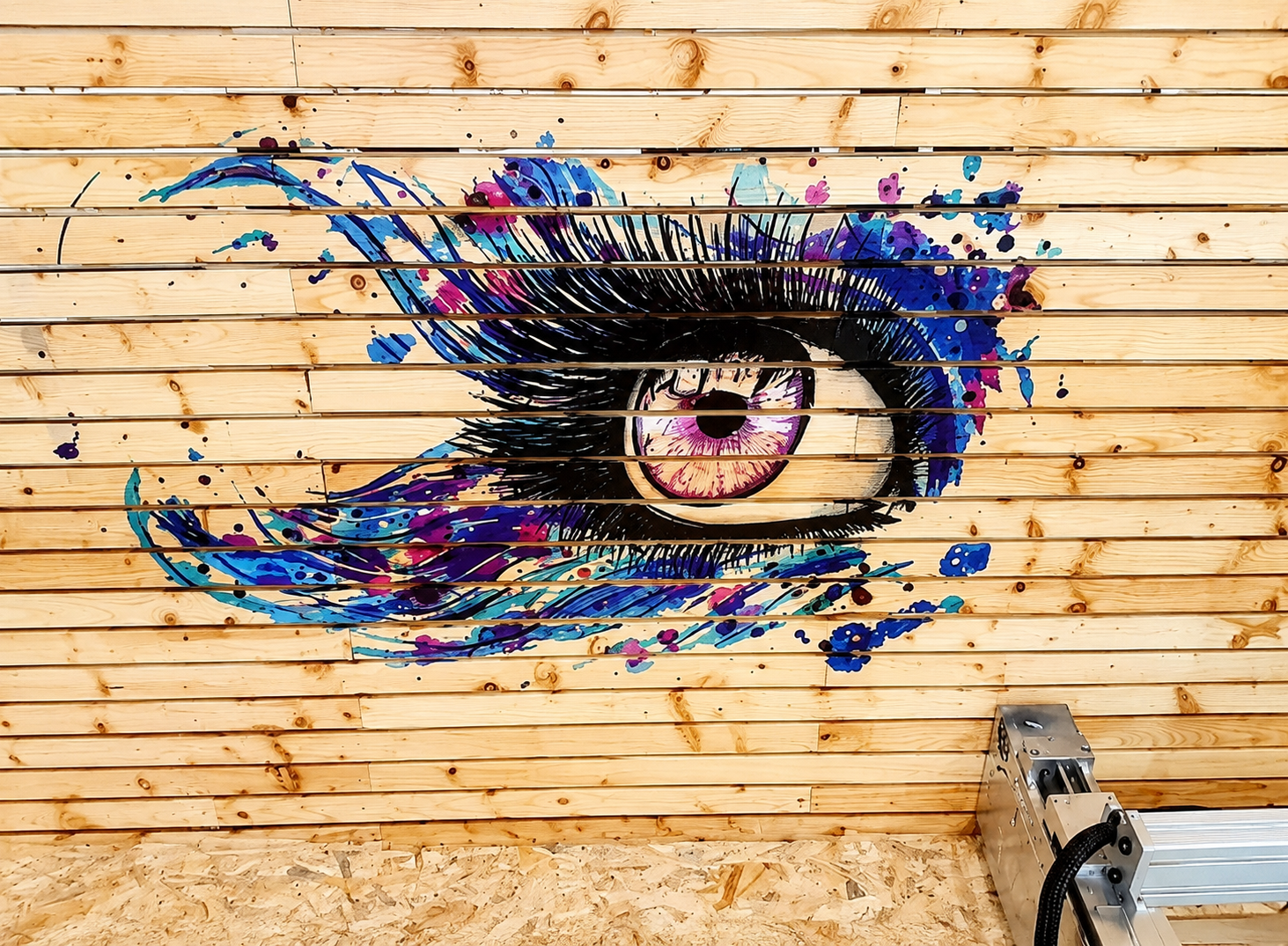
Wood and MDF
MDF is one of the easier rigid panels to print because its surface is relatively uniform.
Light sanding and cleaning are often sufficient, although untreated edges may absorb more ink than the main face. A white or sealed surface normally produces brighter, more predictable colors.
Solid wood needs more attention.
Natural grain may remain visible through the image, which can be desirable for decorative projects but distracting for photographs or fine graphics. Open-grain wood may need sanding and sealing before printing.
Wood also reacts to humidity. Panels that warp, cup or move after printing can affect image alignment and long-term appearance.
Best for: Interior panels, retail displays, furniture elements, signage and decorative feature walls.
Main limitation: Wood grain and dimensional movement may remain visible.
Glass and Mirrors
Glass and mirrors can be printed, but they are nonporous surfaces with little natural grip for ink.
The surface should be completely free from grease, fingerprints, silicone and cleaning residue. A compatible adhesion promoter may be required, particularly when the printed area will be touched or cleaned regularly.
White ink is usually important because color ink alone may appear transparent. Printing white behind the image can produce an opaque design, while selective white ink can create translucent or layered effects.
Reflective surfaces may also affect some optical sensors, so machine calibration should be tested before production.
Best for: Retail displays, office partitions, hotel interiors, decorative glass and branded windows.
Main limitation: Adhesion is highly dependent on cleaning, primer and ink compatibility.
Ceramic Tile
Ceramic tile can support direct UV printing, but the glaze determines the preparation method.
Matte or lightly textured tile may accept ink more easily. Highly polished or glossy tile usually requires careful degreasing and may need a primer or adhesion promoter.
Grout joints create another challenge. Large-format tiles with narrow joints are generally easier than walls made from many small tiles.
If the mural crosses several joints, the image will follow the existing layout. This may be acceptable for decorative effects but less suitable for faces, fine text and precision logos.
Best for: Bathrooms, kitchens, retail interiors, cafés and decorative wall panels.
Main limitation: Glossy glaze and grout lines can affect adhesion and image continuity.
Metal Surfaces
Wall printers may print on aluminum, steel, stainless steel and coated metal panels.
The surface must first be cleaned of oil, grease, fingerprints, oxidation and production residue. Smooth or polished metal often benefits from light abrasion or a material-specific adhesion promoter.
Powder-coated and painted metal may be easier to print than bare polished stainless steel, provided the existing coating is firmly attached.
White ink is usually required on dark metals or when accurate brand colors are important.
Best for: Metal signs, industrial interiors, decorative panels, exhibition structures and branded architectural surfaces.
Main limitation: Smooth passive surfaces can cause ink to peel without proper pretreatment.
Acrylic, PVC and Other Plastics
Rigid acrylic, PVC and ABS panels are commonly used in signs, displays and interior decoration.
They can often be printed with UV ink, but their surface chemistry differs. A preparation method that works on acrylic may not work on PVC or ABS.
Glossy acrylic may require a light surface treatment or adhesion promoter. PVC should be tested carefully because some formulations contain additives that affect ink bonding. Strong solvents used during cleaning may also damage, cloud or crack certain plastics.
Always confirm that the cleaning product, primer and UV ink are compatible with the plastic.
Best for: Retail graphics, exhibitions, office signs and decorative panels.
Main limitation: Adhesion and chemical compatibility vary significantly between plastic formulations.
Wallpaper and Existing Wallcoverings
Printing over wallpaper is possible in some situations, but it adds another layer of risk.
The wallpaper must be firmly bonded, dry, clean and free from loose seams or bubbles. If the wallcovering moves, lifts or separates, the printed image will move with it.
Nonwoven and matte wallcoverings may accept ink more predictably than glossy vinyl-coated wallpaper. Peel-and-stick materials can be risky if the adhesive is weak or the panels are not pressed completely flat.
Existing seams will normally remain visible through the image.
For long-term customer projects, removing unstable wallpaper and printing on a prepared wall may be safer than printing over it.
Best for: Stable decorative wallcoverings, temporary creative projects and controlled indoor applications.
Main limitation: The print is only as secure as the wallpaper adhesive underneath it.

Surfaces That Are High-Risk or Unsuitable
Some materials should not be treated as normal wall printing surfaces.
Constantly wet areas, soft fabrics, flexible curtains, loose panels, heavily damaged walls and surfaces exposed to extreme heat or abrasion may not provide reliable results.
Complex objects with buttons, deep curves, projecting fittings or frequent hand contact are also poor candidates because the printhead cannot maintain a consistent working distance.
Food-contact surfaces, medical environments and regulated areas may require coatings or certifications that standard wall printer ink does not provide.
In these cases, printed panels, vinyl graphics, traditional signage or another decorating method may be more appropriate.
Should You Use Primer or White Ink?
Primer and white ink solve different problems.
Primer improves adhesion or controls absorption. It may be needed on porous concrete, dusty plaster, glass, metal, glossy tile or certain plastics.
White ink controls the background color. It is commonly used on dark walls, colored materials, glass and transparent surfaces to keep the printed colors bright and accurate.
Some surfaces need both.
A dark polished tile, for example, may need an adhesion promoter followed by a white ink layer beneath the final color image.
Neither primer nor white ink should be selected automatically. Test the combination on the real material first.
How to Test a Surface Before Printing
Before accepting a project or purchasing a wall printer, request a test on the material you actually expect to use.
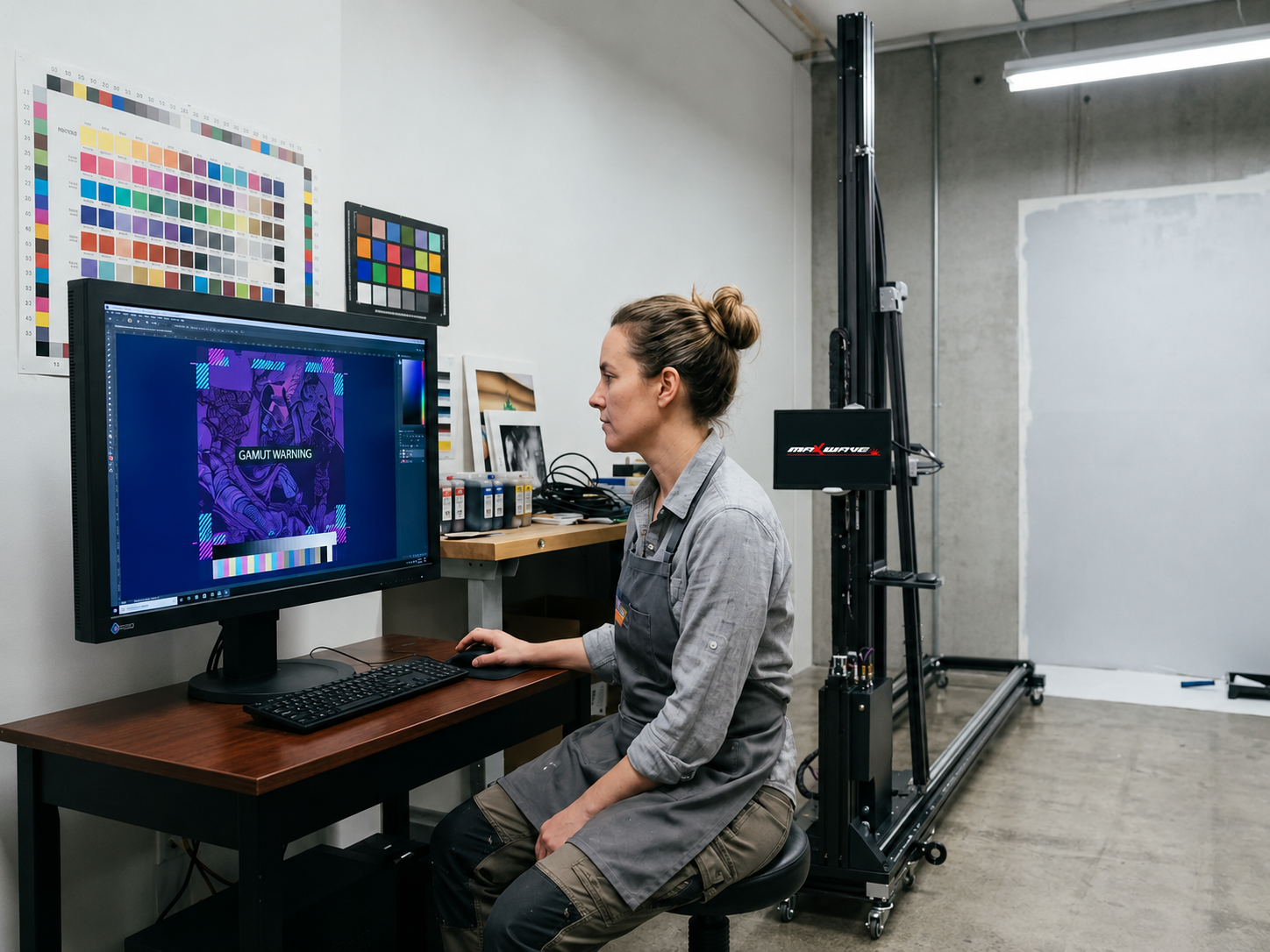
The sample should include fine text, gradients, solid color, dark areas and white ink when required. After printing, inspect image clarity, color, adhesion, surface response and curing.
For nonporous materials, perform a basic adhesion and wiping test. For outdoor or high-contact projects, allow the sample to age before evaluating it.
Also confirm whether the supplier’s distance-sensing system can follow the material texture without losing print quality.
A small test print is faster and less expensive than repairing or reprinting an entire wall.
What Should Buyers Verify Before Choosing a Wall Printer?
A buyer should ask the supplier to demonstrate the wall printing machine on several materials rather than only on smooth white drywall.
The most useful comparison includes a painted wall, brick or concrete, a dark surface requiring white ink, and a nonporous material such as tile, glass, or metal.
For example, WallPrintBox can arrange sample printing based on the buyer’s common wall materials, helping confirm surface preparation, ink adhesion, white-ink performance, and image quality before the final machine configuration is selected.
Ask the supplier to show the complete process, including surface preparation, machine calibration, wall-distance sensing, print settings, and adhesion testing.
The quotation should also explain which primers, inks, and protective coatings are recommended for each material.
A long list of “supported materials” has little value unless the supplier can demonstrate how each surface should actually be prepared and printed.
Conclusion
A wall printer can print on many rigid surfaces, including painted drywall, plaster, concrete, brick, wood, MDF, glass, tile, metal, wallpaper and selected plastics.
Painted drywall and properly prepared plaster are usually the simplest materials. Concrete, brick and wood can also produce strong results but may require sealing, repairs or surface testing. Glass, tile, polished metal and plastic often need an adhesion promoter because they are smooth and nonporous.
The most important factors are not the material name alone.
The surface must be clean, dry, stable, accessible and suitable for the printer’s distance-control range. The ink, primer and wall preparation must also work together.
Planning to print on materials beyond standard painted drywall?
Send WallPrintBox a photo or sample of the surface, together with its dimensions, texture, project location, and intended use. The team can perform a material test, recommend the appropriate CMYK or white-ink setup and pretreatment, and provide a suitable wall printer configuration with an itemized delivered quotation.